
Government by Extortion:
Why Americans Should Be Concerned About Trump's Political Tactics and it's Impact on Public Education

Throughout his political career, Donald Trump has embraced a negotiating style built on leverage, pressure, and ultimatums. Supporters call it hard-nosed leadership. Critics call it something else: political extortion.
Whether one supports Trump’s policy goals or opposes them, Americans should be concerned by a governing philosophy that increasingly relies on withholding unrelated benefits, funding, or legislation until political demands are met.
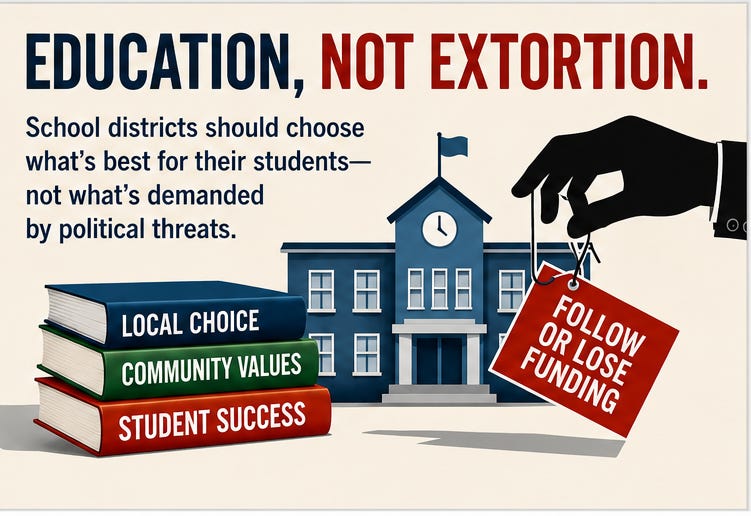
We saw this approach during debates over Diversity, Equity, and Inclusion (DEI) programs in public schools. The Trump administration threatened federal funding for school districts that refused to comply with its directives regarding DEI initiatives and curriculum policies. The message was clear: follow Washington’s preferred policies or risk losing federal support.
Now, now that we just celebrated America 250, many educators and school officials are wondering whether the same playbook will be used again. The administration is developing a national America 250 curriculum or educational framework with the help of forty-one right wing and evangelical organizations. We can anticipate that the curriculum with have both a political and religious bias. Will local districts be given a genuine choice in whether to adopt it? Or will federal education funding once again become the leverage used to force compliance?

Perhaps the greatest irony is that all of this is occurring under an administration that frequently speaks about the importance of local control and reducing the role of the federal government.
Republicans, including President Trump, have long argued that decisions about education, housing, and other community issues should be made closer to the people most affected by them. Yet when local school districts pursue policies the administration opposes, federal funding is threatened. If districts decline to adopt federally preferred approaches to issues such as DEI—or potentially an America 250 curriculum—they face pressure from Washington. That is not local control; it is federal control exercised through financial leverage.
The same contradiction is now evident in the administration’s approach to Congress. Rather than allowing legislators to debate and vote on housing affordability and election policy separately, the administration is effectively linking the two issues together and using one as leverage to achieve the other. If local control and limited government are truly guiding principles, then states, local communities, and elected representatives should be free to make decisions on their merits without the constant threat of financial or political punishment from Washington.
This raises a broader question about consistency in governance. Is local control a principle that applies only when local governments agree with the administration’s preferred policies, or is it a principle that should be respected regardless of political outcomes? Americans deserve an answer. A commitment to local control means accepting that local officials and communities will sometimes make decisions that national leaders dislike. It does not mean allowing local autonomy only when it produces politically acceptable results.
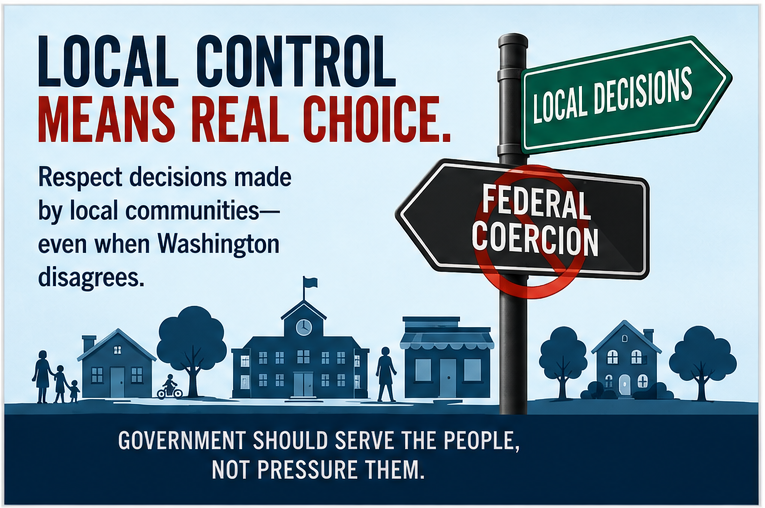
The concern is not simply about a single president or a single administration. It is about establishing a precedent that future presidents of either party may follow. If federal funding can be routinely used as a weapon to compel compliance on unrelated policy matters, then local control becomes little more than a slogan. Genuine local control requires respecting the authority of local communities even when they choose a different path than the one favored by Washington.
Recent events surrounding housing legislation suggest that these concerns are far from hypothetical.

Congress recently passed a bipartisan housing affordability bill designed to increase housing supply and lower costs for American families. The legislation received overwhelming support from both Republicans and Democrats, reflecting widespread recognition that housing affordability has become one of the most pressing economic issues facing millions of Americans. Yet President Trump announced that he would delay signing the housing bill until Congress passes the SAVE America Act, a separate election-related measure that has become one of his top priorities. Reports indicate that Trump has described the voting bill as more important than the housing legislation and has used the housing bill as leverage in an effort to secure Senate action.
Under the Constitution, if the president neither signs nor vetoes a bill within 10 days (excluding Sundays) while Congress is in session, the legislation automatically becomes law. So the housing bill will become law because the President has taken no action.
But the troubling question is not whether one supports the SAVE America Act. Reasonable people can disagree on election policy. The troubling question is why affordable housing for American families was held hostage to an unrelated political objective.
For millions of Americans struggling with rising rents, soaring home prices, and mortgage rates that remain out of reach, housing affordability is not a partisan issue. It is a daily reality. Families unable to purchase their first home, young adults delaying independence, and seniors struggling to remain in their communities all have a direct stake in housing policy.
Yet the administration’s message appears to be that these concerns must wait until Congress delivers a separate election bill.
Critics of the SAVE America Act argue that the legislation could create new barriers for eligible voters. The bill would require documentary proof of citizenship when registering to vote. Voting-rights organizations and some election experts warn that these requirements could make registration more difficult for eligible citizens, including married women whose names differ from those on their birth certificates, younger voters, rural residents, seniors, and lower-income Americans.
Even if one agrees with the goals of the SAVE America Act, using a housing affordability bill as a bargaining chip sets a dangerous precedent and a message that affordability of housing takes the back seat. Americans elect leaders to solve problems, not to create new crises in order to gain leverage in unrelated political fights.
The larger issue extends beyond housing, elections, or education. It is about how government should function. In a constitutional republic, policy debates should be resolved through persuasion, negotiation, and legislative compromise. When leaders repeatedly resort to threats, ultimatums, and the withholding of unrelated benefits to force compliance, government begins to resemble a system of coercion rather than representative democracy.
Americans deserve leaders who can win policy arguments on their merits. They deserve leaders who prioritize solving urgent problems rather than using those problems as leverage in unrelated political battles.
Whether the issue is public education, voting rights, or housing affordability, governing by ultimatum may produce short-term political victories. But it ultimately weakens public trust and undermines the principle that government exists to serve the people—not to pressure them.

 |
|